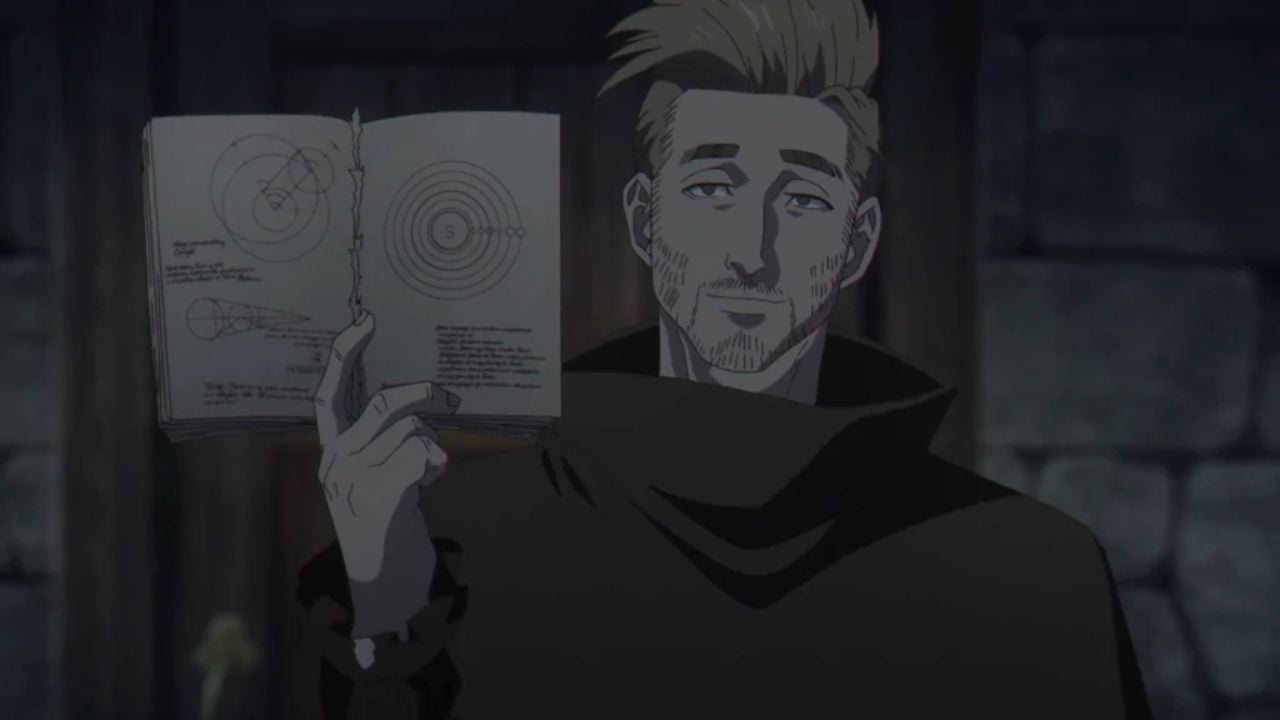
Nowak is one of modern anime’s most ruthless and efficient villains. However, newly released pre-serialization plot for Orb: On the Movements of the Earth has revealed that the character was originally inspired by Hiroshi Nohara, the salaryman father from Crayon Shin-chan.
The early concept sheets were posted by the official X account for the upcoming Uoto 10th Anniversary Exhibition UO10 and were released to show how the manga took shape prior to serialization.
The prototype for Nowak is described in these documents as an ordinary, worn-out, middle-aged Inquisitor who carries the demeanor of a civil servant or middle manager.
Author Uoto wanted his character image as a blend of a figure, whose name was redacted, and Shin-chan’s father Hiroshi Nohara, sporting short hair and stubble while constantly sighing and complaining about his work.
Coming from a secular background and holding zero personal interest in theology or heliocentrism, the inquisitor performs his duties solely to support his household.
Uoto revealed that he designed Nowak as a shadow-protagonist of the 40-year story, serving as the only figure alongside the mathematical formulas to survive across all three generations.
This early concept note aligns with Uoto’s comments made during a 2024 interview, where he explained how he envisioned the character’s voice and workaholic mindset while drawing the manga.
“For Nowak, I vaguely had an image like Hiroshi Nohara,” Uoto said in that interview. “He continues to appear throughout the entire work and is in a position where he is constantly tossed about by various eras, working hard for the sake of his family.”
While the early concept documents redacted the name of the second person who inspired Nowak, Uoto might have already revealed this.
In a 2021 interview, the author had noted that Nowak was modeled on Nazi bureaucrat Adolf Eichmann, who organized the deportation of Jews to Auschwitz.
According to Uoto, Eichmann is often viewed as a cog who lacked decision-making power instead of a monster, as he calmly carried out atrocities taking routine orders from his superiors.
“In short, I think Nowak is that kind of person too. He isn’t a fanatic at all; he simply tortures and executes heretics every day as a job that is part of his daily life, solely because he was ordered to from above. […]Precisely because of that, he also has a side that cherishes his family and friends, and I wanted to bring out the horror of how easily human beings can calmly commit cruel acts as ‘work’ the moment they stop questioning things.”
Uoto (2021 interview with Real Sound Book)
Early Plot Concept for Orb: On the Movements of Earth:
Following text contains MAJOR SPOILERS for those who have not watched the anime or read the manga.

The pre-serialization concept show that Orb was planned to span 40 years across roughly five to six volumes, with three generations of protagonists.
The first protagonist, a 10-year-old boy genius who served as the prototype for 12-year-old Rafal in the Part 1 story arc, was originally scheduled to appear only in Chapter 1, or Chapters 1 and 2 at most.
Described by Uoto as an unpleasant, overly perfect prodigy who looks down on others like Light Yagami from Tsugumi Ohba and Takeshi Obata’s Death Note, the boy was meant to discover heliocentrism, hide his incomplete planetary calculations in a wooden chest, and be immediately executed by hanging or burning at the stake.
Ten years after the 10-year-old prodigy’s execution in the Part 1 arc, the Part 2 arc follows an 18-year-old apprentice and his research partner, a single composite prototype who was later split into Oczy, Gras, and Badeni, as they find the hidden chest and recruit a 13-year-old girl barred from academics who secretly happens to be the inquisitor’s daughter, the prototype for Jolenta.
After the young researchers accidentally befriend the off-duty inquisitor at a tavern, a stray clue from the first protagonist exposes their work, leading the villain to torture and execute the duo.
Directly afterward, the inquisitor learns his own daughter was sentenced to burn for joining their research, and although a fellow inquisitor secretly helps her escape, she vanishes from the story entirely, unlike the final version of the Part 3 story arc where Jolenta returns decades later as the leader of the Heretic Liberation Force.
Set 30 years after Part 2, the Part 3 of the draft pairs an 18-year-old literate nomad burglar, the prototype for Draka, with a liberation leader modeled on Schmidt as they recover the second generation’s formulas and trap the now 66-year-old inquisitor in a fatal explosion.
Following an allegorical dialogue across time and a mutual defeat that destroys most of the research, a final epilogue chapter set two years later introduces a 20-year-old Polish dairy farmer’s son who finds surviving fragments of the data and resolves to enter university, revealed to be historical astronomer Albert Brudzewski.
This early version came without the final manga’s twist featuring an adult version of Rafal.
Details Regarding Uoto’s 10th Anniversary Exhibition:
The early concept of Orb manga serves as a preview for the Uoto10th Anniversary Exhibition UO10., the creator’s first solo retrospective running from Dec. 19, 2026, to Feb. 23, 2027, at the YURAKUCHO MUSEUM in Tokyo.
The exhibition will display approximately 150 original drawings, storyboards, and concept notes from Orb and other works of the author including 100 Meters and Welcome to FACT.
In addition to the archival displays, a recreation of Uoto’s workspace will be installed inside the venue, where the author will periodically draw manuscripts for a new serialization and display the completed pages on-site.
The exhibition follows Uoto’s recent announcements of two upcoming manga serializations, Hallucinationmeat and Test Taker Cheaters, alongside his first prose book, Anti-Serialization Hypothesis, slated for release on Dec. 2, 2026.
Serialized in Shogakukan’s Weekly Big Comic Spirits between 2020 and 2022, Orb: On the Movements of the Earth surpassed 5.7 million copies in circulation and won the 26th Tezuka Osamu Cultural Prize Grand Prize in April 2022.
Set in 15th-century Europe, the story follows a multi-generational struggle between Church inquisitors enforcing geocentrism and scholars risking their lives to prove that the Earth revolves around the Sun.
A 25-episode anime adaptation of the work by Studio Madhouse aired from October 2024 to March 2025, with the series also having a stage play adaptation directed by Avshalom Pollak, with a script by Keishi Nagatsuka.