
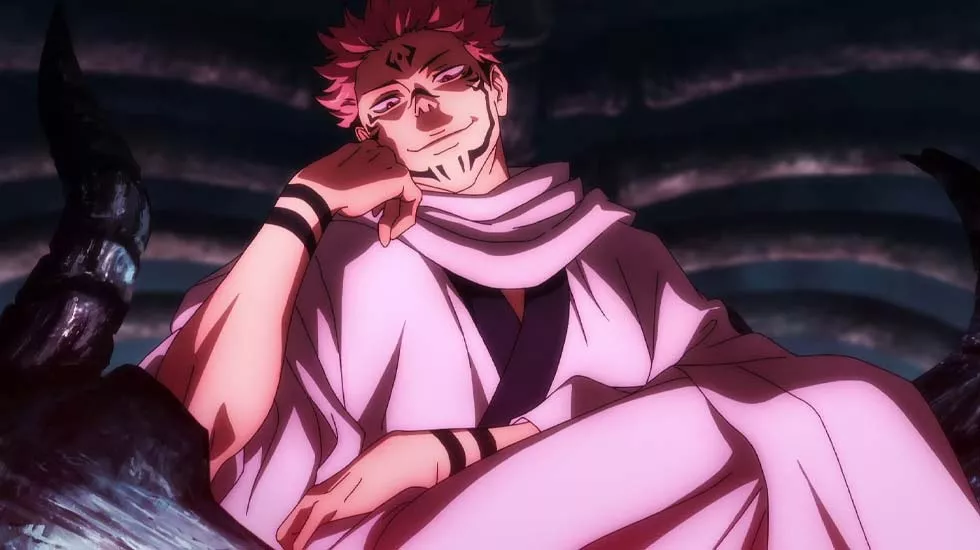
Ryomen Sukuna, the King of Curses from Jujutsu Kaisen, is instantly recognizable by his striking array of tattoos.
These markings, covering his face, body, and even his hands, have become iconic among fans, sparking countless fan art, cosplay, and even real-life tattoos.
But are they simply aesthetic choices, or do Sukuna’s tattoos hold a deeper meaning? Since we are talking about Jujutsu Kaisen, it’s highly likely that these markings aren’t just for show, because Akutami has used a lot of different references in the story.
In this article I’ll be taking a look at the possible explanations behind Sukuna’s enigmatic tattoos.
Please keep one thing in mind, Akutami has not given us any confirmation regarding whether Sukuna’s markings have a deeper meaning or not. So, this article is strictly speculative.
What do Sukuna’s Tattoos mean?
At first sight, it seems that Sukuna’s tattoos are just there for aesthetic purposes. However, after doing some digging, I realized that they could actually have a deeper meaning.

Tattoos have had quite an interesting history in Japan. From being seen as something that has spiritual significance during the Yayoi period (300 BC – 300 AD). Tattoos also represented social status on many occasions.
However, by the Kofun period (300 – 538 AD), tattoos were seen in a more negative light, often associated with criminals and outsiders. So, Sukuna sporting the tattoos could be Gege’s way of showing us that the King of Curses is up to no good.
It could also point to his mythological roots, if we look closer.
Sukuna’s tattoos & his mythological origins:
According to texts from Nihon Shoki, there was a man in the Hida Province named Sukuna. However, he was someone who went against the imperial directives, meaning he opposed the emperor of Japan.
As a result, the emperor had passed a verdict for Sukuna to be vanquished.
In the year 65, there was a man in Hida Province. He was named Sukuna. The man had a single head and torso with two faces, each face oriented in opposite directions. The two faces met at the top but had no nape. Each face was served by its own set of appendages. Each had knees but no ankles. He had tremendous power but still could move quickly. With two pairs of arms, he held swords, a bow and an arrow. Sukuna refused to comply with imperial directives. He threatened and plundered the people. Whereupon the emperor dispatched the founder of Wanibe no omi Naniwaneko Takefurukuma to vanquish the creature.
Now, in Japan the renegade clans who opposed the Emperor were called the Tsuchigumo. These clans have often been depicted as giant, monstrous spiders – that have turned into a well known yokai of today.
Here’s where the tattoo part comes in. The Tsuchigumo were said to have tattooing traditions, to showcase that they were outsiders. On top of that, the Tsuchigumo yokai is also depicted with markings of some sort in legends.
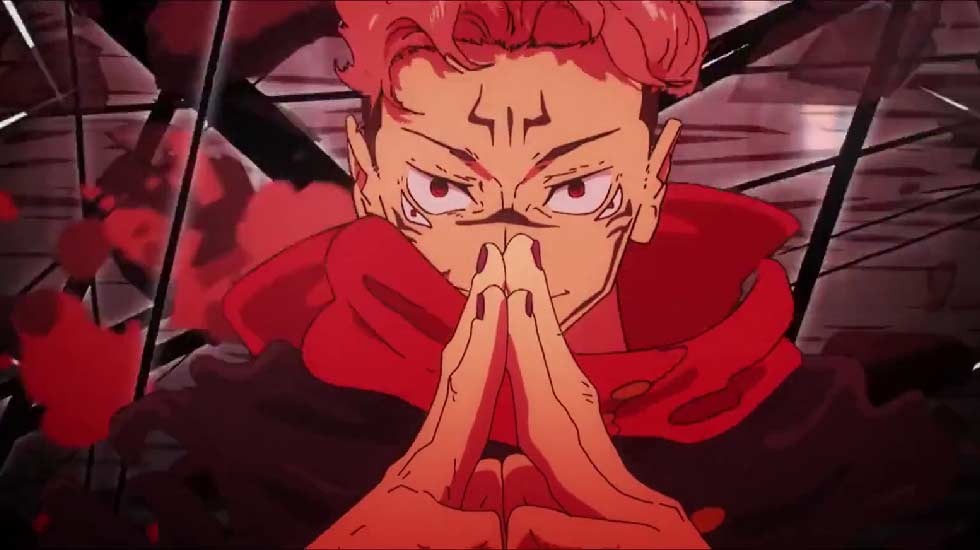
The marking that Sukuna has on his forehead is eerily similar to that of the Yokai spider. Meaning, this could signify Sukuna as a member of a renegade local clan who went against societal norms.

This sits well with his established image of a trouble maker – a calamity if you may.
Interestingly, the Uncanny Japan podcast noted that in Eastern Japan there was a group of such indigenous local clans, the Tsuchigumos, who disobeyed the Yamato court.
It is rumored that their leader was either a very strong person, or a pair of brothers who looked alike/twins, who fought together. Sukuna? Well, that’s one mythological connection I felt was relevant when it came to Sukuna’s tattoos.
Now that we have discussed the origin aspect, let’s take a look at the other tattoos on Sukuna’s body and what they could probably mean!
Sukuna’s hand tattoos:
Unlike the Tsuchigumo, Sukuna’s hand tattoos appear to be inspired by the irezumi kei, or tattoo penalty, which was likely inspired by the Chinese way of punishing wrongdoers.
This involved tattooing petty criminals, including thieves and robbers, on the arms and wrists as a form of punishment and identification. It was a much more lenient punishment compared to the death penalty or chopping off a hand.
Now, the historical accounts in the Nihon Shoki describe Sukuna as a “plunderer” and a “thief”, so Akutami deciding to give the King of curses such tattoos makes sense.
Check out the following image for another interesting detail regarding the tattoo.

Matching Sukuna’s band markings with the tattoos in the above image indicates that he was marked for a crime committed in the Nara region.
If the Nara region doesn’t sound interesting enough for you, then here’s a piece of history to catch your attention. This region holds historical significance as the former Yamato province, the central hub during the Kofun and Asuka periods.
Myths suggest Sukuna existed during this time and opposed the Yamato court, adding another layer of meaning to the Nara-related tattoo on his arms.
A translation of the Sukuna legend from the Nyukawa village in Gifu Prefecture (formerly Hida Province) offers additional context (thanks to Tempenensis for the translation):
During ancient history of Japan from the early days of Yamatai country, there isa mysterious 4th century. In other words, a period of 100-years leading up to the development of the Yamato dynasty. In the literature, it was the era of the establishment and development of royal authority as depicted in “Kojiki” and “Nihonshoki”. It was also the time when large Kofun era started. The power of the Yamato court had reached to Hida since more than 1.500 years ago, and Ooyahashi no Mikoto was appointed as Hidakokuzo*. Ryomen Sukuna who controlled Hida, did not obey the court so Takefurukuma no Mikoto advanced the suppressing force as ordered by Emperor Nintoku.
And coming to the wrist tattoo, these markings were given to the “Hinin” (非人), a term used to refer to outcast groups and criminals during Japan’s feudal era. The word literally means “non-human” or “not a person,” a fitting description for the King of Curses, who has also been referred to as a calamity.

There is only one small downside. These specific tattoo designs were primarily used during the Edo period, long after the Heian era when Sukuna is believed to have lived. Even so, the first records of a tattoo being used as a punishment can be traced back to 720 A.D (which is during the Heian era).
This suggests that Gege Akutami likely drew inspiration from these later designs to add more depth to Sukuna’s character design.
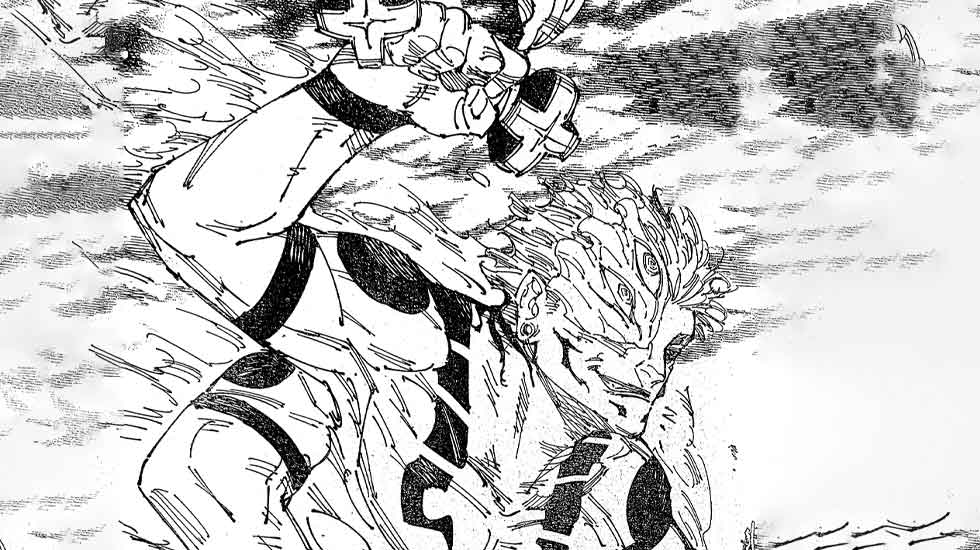
On top of that, Sukuna’s arm tattoos undergo a transformation when he enters his true form. The original two bands on his wrist and upper arm morph into a single band on each arm. Check out the image below!

The meaning behind this alteration remains unclear as of now.
Sukuna’s face tattoos:
Coming to the face tattoos that Sukuna had, they once again are rooted in the tattoo penalty tradition. However, instead of petty crimes, markings on the face indicated a more serious crime in most cases, as murderers were commonly plastered with these.
While his face tattoo does not correspond to any known markings from the Edo period, the one on his forehead does look eerily similar to the Tsuchigumo yokai representation.
However, the forehead marking disappeared once he entered his true form. So once again, the meaning behind this remains unclear.
Sukuna’s facial markings could also be a callback to the Jomon era tattoos on faces, which could have been “rites of passage or cultural traits intended to have been cultural/tribe identifiers”.
Check out the following image for reference:

Now that we have explored the possible meanings behind Sukuna’s tattoos, I would like to talk a bit about a theory that was once rife in the JJK fandom!!
The tattoo theory:
One interesting theory among Jujutsu Kaisen fans on Reddit and other online forums was that Sukuna stores cursed techniques he stole or ingested (thanks to the big mouth in his stomach) within his tattoos.
This idea gained traction due to the mysterious “Open” technique, which was initially shrouded in secrecy when revealed during the Shibuya arc. In the manga, the redacted word of the open technique was shown as a black box.
This black box was taken literally, and fans speculated that each box shaped tattoo on his chest represented a different cursed technique. And when Sukuna “opens” one, the corresponding tattoo would disappear, letting him use that technique.
Versions of this theory became more popular because the tattoo on Sukuna’s forehead was shaped as a trident, which many took as Sukuna storing one of his weapon.
However, this theory is on its last legs following the recent reveal behind what the open technique and fire arrow really were. Turns out, cursed techniques aren’t really stored within a specific tattoo.
What are your thoughts on Sukuna’s tattoos in Jujutsu Kaisen? Do you think they serve a deeper meaning than just the aesthetics? Let me know your opinions in the comments below!!






![[Exclusive] The Great Indian Anime Show: The Journey Behind India’s First Ever Anime Talk Show](https://animehunch.com/wp-content/uploads/2026/01/Analyst6-150x150.webp)