

Nhentai.net, a prominent platform for sharing adult content, filed a motion to dismiss a copyright infringement lawsuit brought by California-based PCR Distributing.
PCR, operating under brands like J18 and JAST USA, alleged that Nhentai hosted copyrighted material without authorization, claiming this posed a threat to its business.
In response, Nhentai challenged the allegations on multiple legal and procedural grounds.
Background of the Case:
PCR’s legal actions began with a DMCA subpoena aimed at unmasking Nhentai’s operators, citing the platform’s failure to process takedown requests.
After opposition from Nhentai, PCR escalated the dispute by filing a lawsuit in the Central District of California. The complaint accused Nhentai of sharing copyrighted works without securing proper permissions.
Nhentai’s motion to dismiss argued that PCR failed to meet the standards for copyright infringement and raised issues concerning ownership, permissions, and timeliness of the claims.
A detailed breakdown of Nhentai’s defense:
1. Ownership Discrepancies
Nhentai stated that PCR has not demonstrated legal ownership of the works in question, a fundamental requirement for filing a copyright infringement lawsuit.
The defense highlighted several inconsistencies noting that public records listed JAST USA, not PCR, as the copyright owner for some of the works. JAST USA, it stated, was a separate corporate entity with distinct ownership and operations, undermining PCR’s claim of ownership.
Nhentai also argued that PCR failed to provide evidence of any licenses or assignments from JAST USA granting it the right to enforce these copyrights. The motion contended that vague references to “negotiating contracts” were insufficient to establish ownership or exclusive rights.
The company pointed out that certain copyright registrations listed JAST USA, not PCR, as the legal claimant, calling PCR’s standing to sue into question.
2. Unclear Scope of Copyrighted Material
Concerns were also raised by the defense about the clarity of PCR’s claims regarding what was actually copyrighted:
- Classification as Literary Works: Nhentai asserted that some of the registered copyrights were classified as “literary works,” which explicitly exclude images under U.S. copyright law. This distinction was critical because the lawsuit primarily involved images shared on Nhentai.net.
- English Translations: Nhentai noted that some registrations were for “English translations” of original works, which might not cover the images themselves.
- Lack of Specificity: The motion criticized PCR for failing to specify how the allegedly copyrighted materials overlapped with the content hosted on Nhentai.net. Nhentai argued that this lack of detail left both the defendants and the court unable to evaluate the claims.
3. Permission already granted?
Furthermore, Nhentai presented bombshell evidence that PCR representatives had granted explicit permission for the use of their content on the site, citing communications from 2020 in which PCR representatives, including those from J18 and JAST USA, explicitly allowed the platform to host their works.
One email stated that it “isn’t a takedown request or a DMCA” further stating that a market for anime and manga exists in the west due to piracy.
Additional emails revealed that PCR had explored running banner advertisements on Nhentai.net to promote its products.
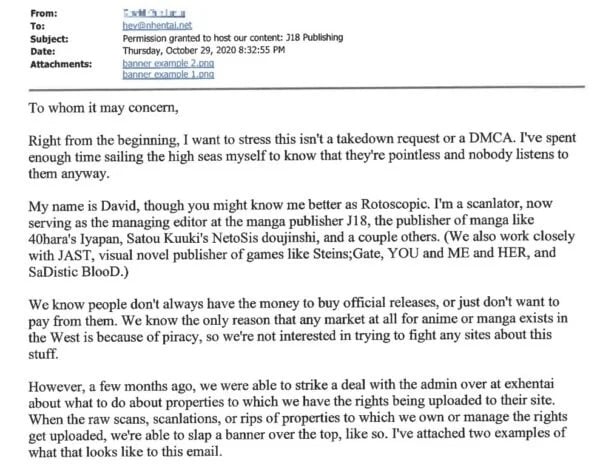
Nhentai argued that these communications demonstrated a collaborative relationship, negating any claims of unauthorized use.
They also highlighted that these permissions were never formally revoked.
4. Statute of Limitations
The defense argued that PCR had been aware of the alleged use of its works since 2020, as evidenced by the permissions granted during that time. They asserted, due to this, that many of PCR’s claims were barred by the three-year statute of limitations under the U.S. Copyright Act.
Nhentai contended that the continued presence of works on its site did not constitute separate acts of infringement and that the statute of limitations had already elapsed for the claims.
5. Unrelated Website Claims
Nhentai also sought to strike all claims related to the domain Nhentai.to, stating that it operated independently and had no affiliation with Nhentai.net.
The defense emphasized that the inclusion of Nhentai.to in the lawsuit was irrelevant and should be dismissed.
Nhentai also criticized PCR’s request to transfer ownership of the Nhentai.net domain as excessive and baseless. The website stated that it hosted over 500,000 pages, while PCR’s claims concerned fewer than 1% of them.
The defense argued that transferring ownership of the entire domain was unwarranted.
Nhentai further noted that granting PCR control over the domain would disrupt existing contracts with other companies, further demonstrating the unreasonableness of the request.
What Next:
PCR has not yet responded to Nhentai’s motion to dismiss but is expected to file a reply soon. The court will then evaluate the arguments presented by both sides to determine whether the case will proceed or be dismissed.
This decision could set a significant precedent for how copyright disputes involving online platforms are handled in the future.
Source: TorrentFreak











![[Exclusive] The Great Indian Anime Show: The Journey Behind India’s First Ever Anime Talk Show](https://animehunch.com/wp-content/uploads/2026/01/Analyst6-150x150.webp)